
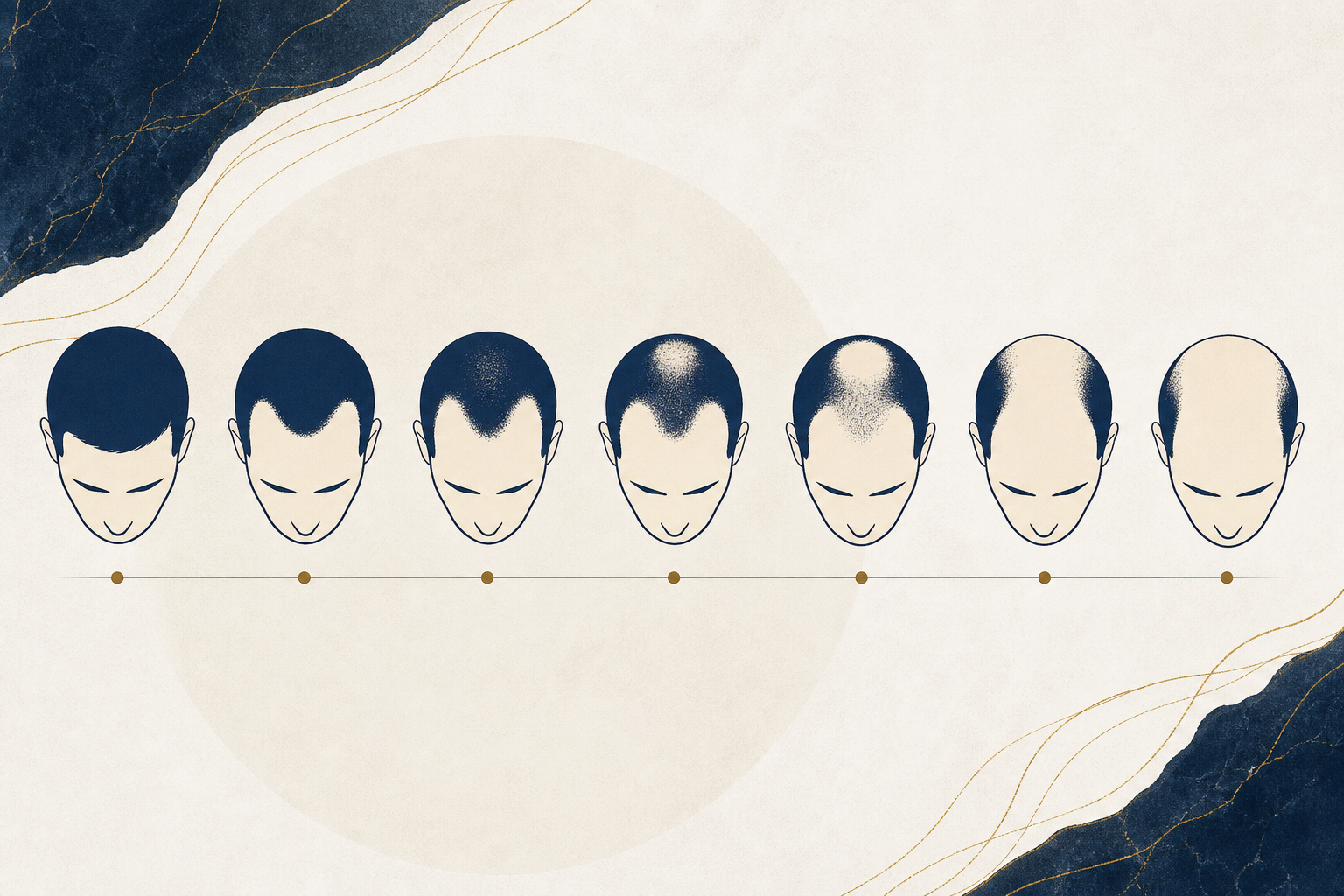
In brief
The Norwood–Hamilton scale is the standard visual classification for male pattern hair loss. It runs from Stage I (no significant recession) to Stage VII (only a horseshoe of hair remains at the sides and back). The scale describes how far loss has progressed — it does not, by itself, tell you whether you need a transplant, medication, or neither. That requires a clinical assessment of donor density, goals, and medical history.
Why the scale matters
Surgeons and trichologists use a shared language so “moderate crown thinning” means the same thing in Manchester, Birmingham, or London. For you, matching your pattern to a stage helps prepare questions for consultation — not self-diagnose online.
Competitor blogs often mention Norwood in passing (UK Hair Transplants has a single “Hair Loss Stages” post). Few UK clinics offer a clear, stage-by-stage guide without pushing immediate surgery. This article is education-first.
Norwood stages at a glance

| Stage | What you typically see |
|---|---|
| I | No visible recession — often called a juvenile hairline. |
| II | Slight temple recession (“mature hairline”). |
| IIa | Frontal recession moving back across the forehead. |
| III | Deeper temporal recession — often the first stage considered cosmetically significant. |
| III vertex | Stage III plus thinning at the crown. |
| IV | Larger frontal/temporal recession and a more pronounced bald crown; a band of hair still separates front and top. |
| IVa | Loss spreads backward across the top; crown less dominant. |
| V | Front and crown zones begin to merge; the bridge of hair thins. |
| Va | Extensive top loss; vertex pattern less isolated. |
| VI | Front and crown merge into one continuous area. |
| VII | Most advanced — narrow horseshoe at sides and back. |
Source framework: Norwood OT (1975), Hamilton revision lineage — see .
Stage III: the conversation starter
Many men first seek advice around Stage III or III vertex — visible temple recession and/or crown thinning. At this point, options often include:
- Medical therapy (e.g. minoxidil, finasteride — prescription and suitability assessed by a clinician).
- Monitoring with photography if loss is early and progression unclear.
- Surgical planning if loss is stable enough to design a long-term hairline and donor plan.
HTC does not publish graft counts by stage online. Estimates require in-person donor assessment.
Advanced stages (VI–VII)
Higher stages mean less donor hair relative to the area to cover. That does not automatically rule out treatment — but expectations must be realistic: coverage density, hairline design, and whether a transplant is the best use of donor supply are surgeon decisions.
Norwood vs Ludwig (women)
Female pattern loss is usually classified with the Ludwig–Savin scale (diffuse central thinning). Men’s Norwood patterns are a poor fit for many women’s presentations. HTC offers separate assessment pathways for female patients — this guide focuses on male pattern loss.
Common mistakes when using the scale
- Comparing to celebrity photos — lighting and styling distort stage.
- Ignoring progression speed — two people at Stage III can have very different futures.
- Treating stage as a sales tactic — “you must be Stage IV to book” is a red flag.
- Skipping medical causes — shedding from stress, illness, or medication can mimic pattern loss; GP or clinician review may be needed.
What to do after identifying your likely stage
- Take consistent photos (same lighting, dry hair, pushed back).
- Note family history and when recession accelerated.
- Book a free consultation with a GMC-registered surgeon for a formal classification and plan.
Frequently asked questions
What is the Norwood scale?**
A standardised seven-stage system (with substages) describing male pattern baldness from minimal to extensive loss.
Can I diagnose my own Norwood stage?**
You can estimate for education; clinical classification should be confirmed in person.
Which Norwood stage needs a hair transplant?**
There is no universal stage threshold — donor density, age, stability, and goals all matter.
Is Norwood III too early for surgery?**
Sometimes III is appropriate; sometimes medical therapy or monitoring is better. Only assessment can answer.
Does the scale apply to beard or eyebrow loss?**
No — it is for scalp male pattern loss. Beard and eyebrow restoration use different planning tools.