Surgical restoration
FUE Hair Transplant UK
Surgeon-led follicular unit extraction for hairline, crown, and density goals — planned around your donor area, hair loss pattern, and long-term restoration, assessed at a free consultation.
In brief
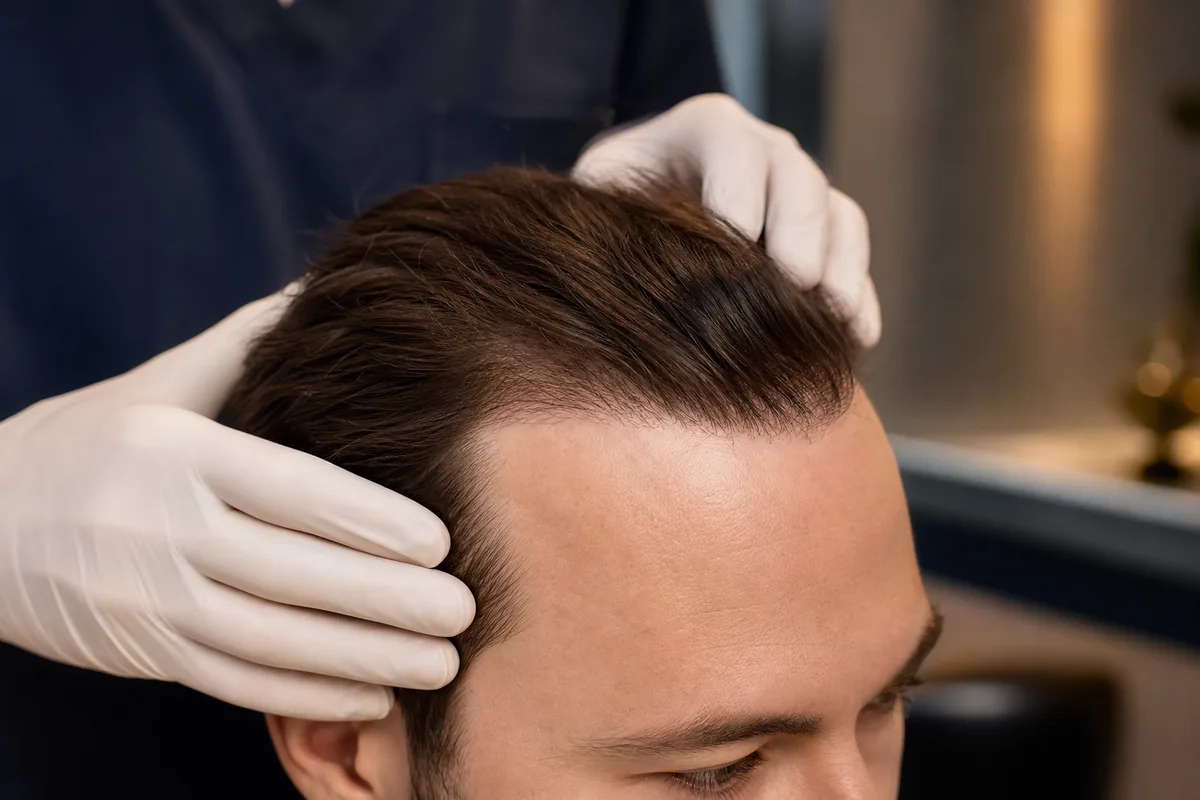
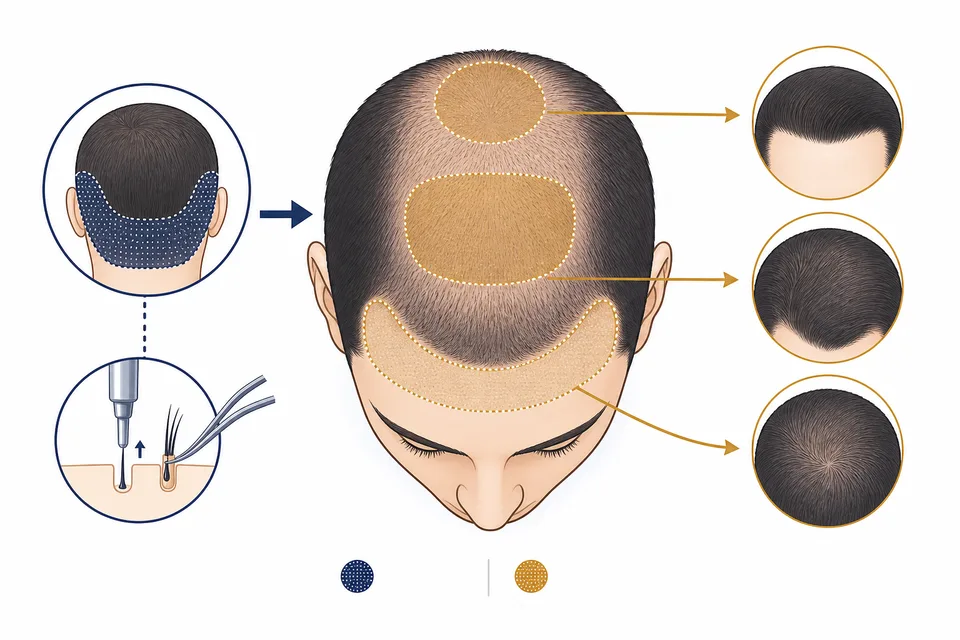
FUE (follicular unit extraction) removes individual hair follicles from the donor area at the back and sides of the scalp, then implants them into thinning or balding regions. There is no strip incision, so there is typically no linear scar. Suitability depends on diagnosis, donor density, scalp health, and goals — a GMC-registered surgeon should assess you before you commit.
What is an FUE hair transplant?
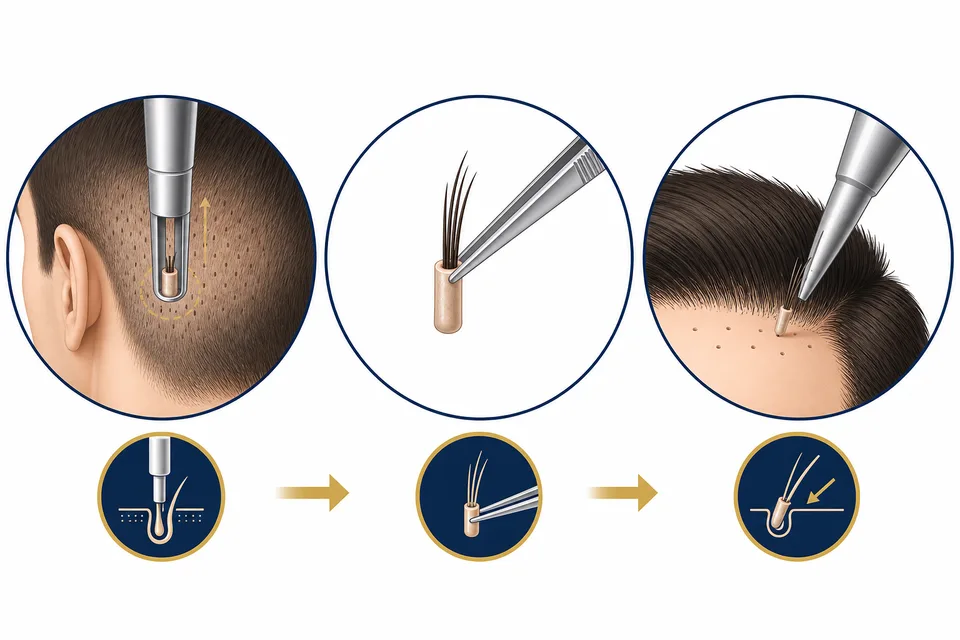
FUE is a surgical technique, not a medication or laser device. The surgeon uses a small punch to extract naturally occurring follicular units — groups of one to four hairs — one at a time from the donor zone. Grafts are sorted, kept viable, and placed into recipient sites at planned angles and density.
At HTC, scalp FUE follows the same principle as our beard and eyebrow work: one surgeon, one patient, with Dr M Husnain (GMC 8023362) or a colleague surgeon performing your procedure from first graft to last.
Who may benefit from FUE?
Patients explore FUE when medical or non-surgical options are not enough for their goals. Common consultation reasons include:
- Receding hairline or temple thinning
- Crown or diffuse thinning with realistic density targets
- Beard or eyebrow restoration using the same FUE principle
- Scar camouflage where hair no longer grows
- Afro or textured hair — technique adapted for curved follicles and growth direction
Not everyone is suitable. Active scalp inflammation, unstable hair loss, limited donor density, or unrealistic density expectations may mean surgery is deferred or a different technique is recommended. We will say clearly at consultation if FUE is not the right step yet.
How FUE works at HTC
Your pathway starts with a free consultation: medical history, examination, and often a Proscopic scalp scan to assess miniaturisation and donor quality. Hairline design, graft distribution, and technique (FUE vs FUT where relevant) are discussed before any quote.
On procedure day, the donor area is prepared and local anaesthetic is used. Follicles are extracted individually, then implanted into recipient sites. Most full sessions take the best part of a day, depending on graft count — you remain awake, can take breaks, and go home the same evening.
We do not publish graft counts or fixed prices online. Both depend on your pattern of loss, hair type, skin condition, and the plan agreed with your surgeon.
FUE vs FUT — which might suit you?
FUT (strip harvest) removes a band of donor tissue and dissects it into grafts; it can suit some patients who need higher graft numbers in one session, depending on donor quality. The trade-off is a linear donor scar and different recovery at the back of the head.
HTC offers both techniques where clinically appropriate. The choice is made after examination — not from a generic online rule. Read our FUE vs FUT guide for a plain-language comparison, then book consultation for a personal recommendation.
Design, density, and natural results
Natural-looking restoration depends on hairline shape (soft and irregular, not a straight wall), graft angle matching your native hair, and density that respects donor limits. Planning should look credible at year one and still make sense as you age.
Shock shedding of transplanted hairs in the first weeks is common and usually temporary. Visible improvement builds over months; we set timeline expectations at consultation rather than promising a date from marketing photos.
Recovery and aftercare
Most patients return to desk-based work within a few days, with redness and crusting reducing over one to two weeks. Donor sites heal as small dots rather than a long linear scar. HTC includes 12 months aftercare — written instructions, check-ins, and in-clinic reviews at the same UK clinic where your procedure took place (Manchester, Birmingham, Bristol, or London).
Honest expectations
- Donor hair is finite — density goals must match what your donor can support
- Surgery does not stop future hair loss — ongoing medical therapy may be discussed where appropriate
- Scalp conditions (dryness, redness, dermatitis) must be stable before surgery
- A second session may be needed for large areas or high density targets
- Results vary by healing, technique, and aftercare adherence
Frequently asked questions
How much does an FUE hair transplant cost in the UK?
Cost depends on area treated, graft count, technique, and surgical time. HTC gives transparent, personalised pricing after a free consultation — we do not publish fixed menu prices online.
How long does an FUE procedure take?
Most full FUE sessions take the best part of a day, depending on graft count. Smaller hairline cases are shorter. Your clinic team confirms timing after planning.
Is FUE permanent?
Transplanted follicles are generally long-lasting once established. Native hair may continue to thin elsewhere, so long-term planning and aftercare matter — discussed at consultation.
Does FUE leave a scar?
FUE does not remove a strip of scalp, so there is no linear strip scar. Tiny extraction sites usually heal as small dots that are hard to see once surrounding hair grows back.
Who performs the surgery at HTC?
A GMC-registered surgeon plans and performs your procedure with an experienced clinical team. Surgeon profiles and GMC numbers are published on our site.
Can I have FUE with Afro or textured hair?
Yes — HTC regularly performs FUE for textured hair with technique adapted to curved follicles and growth direction. Suitability is confirmed at an in-person consultation.
Book an FUE hair transplant consultation
Free, no obligation. We will assess donor hair, hair loss pattern, and whether FUE — or another pathway — is appropriate for your goals.
Results evidence
Documented cases.
Before-and-after photography is published only with patient consent and clinician review. Individual results vary and are discussed through consultation.
Published cases will appear here once consent and clinician review are complete.
Individual results vary. Images are published with patient consent only.
Free consultation
Start with clinical clarity.
Book a free consultation to discuss suitability, treatment options, and personalised next steps with a clinician-led clinic.
Confidential enquiry. No obligation. Pricing is personalised after consultation.