In brief
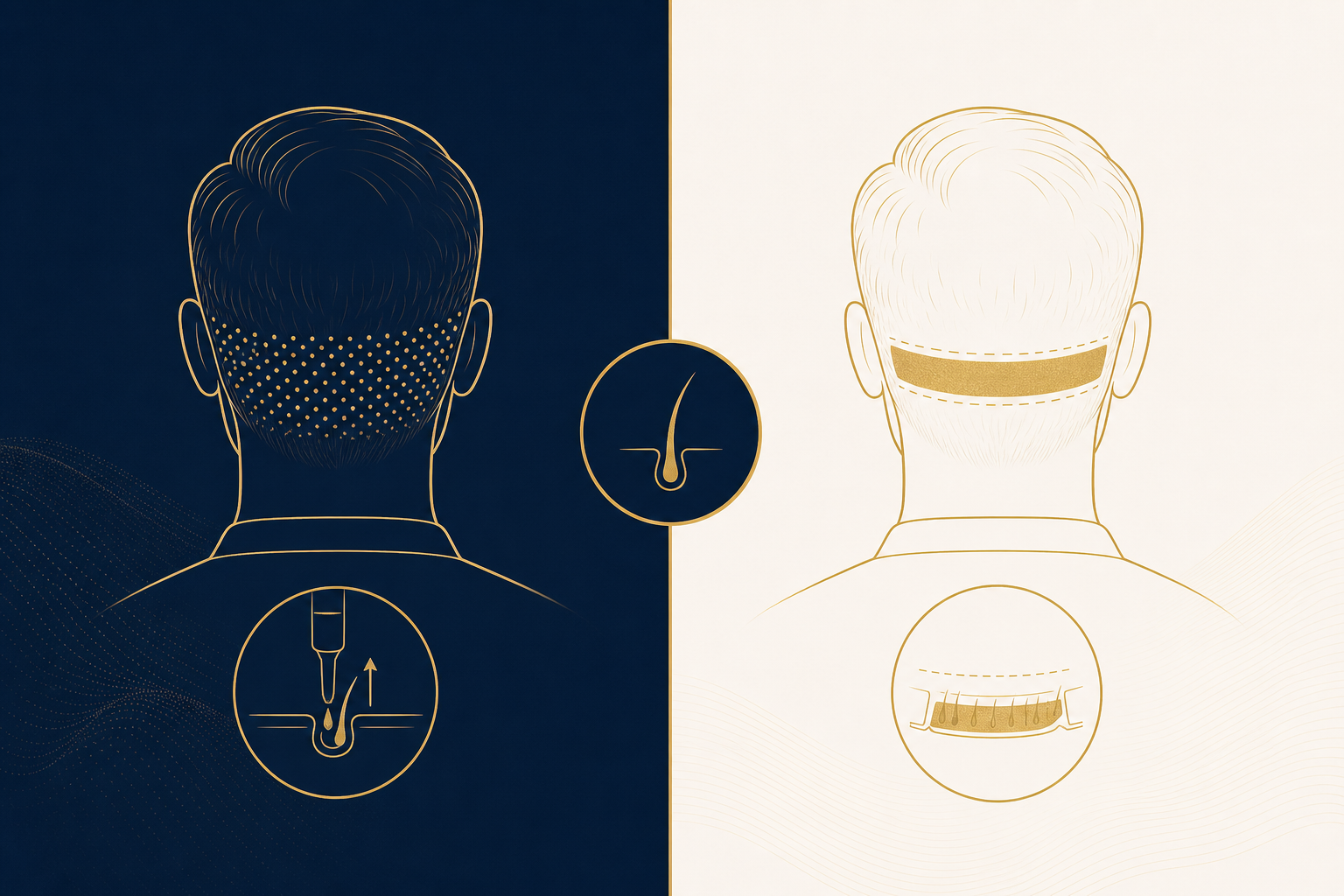
FUE (Follicular Unit Extraction) removes individual follicles directly from the scalp using a small punch tool — leaving no linear scar. FUT (Follicular Unit Transplantation) removes a strip of scalp from the donor area, from which individual grafts are dissected — leaving a single linear scar that is usually hidden under hair.
Both techniques transplant the same type of grafts. The difference lies in how those grafts are harvested. For most UK patients today, FUE is the preferred approach — it heals faster, leaves less visible scarring, and suits a wider range of lifestyles. FUT may still be considered in specific circumstances where a high graft count is needed from a limited donor area.
The right choice depends on your hair loss pattern, donor density, lifestyle, and what you’re trying to achieve. A suitability assessment with a GMC-registered surgeon is the only reliable way to know which is right for you.
What FUE actually is

In an FUE procedure, the surgeon uses a small circular punch (typically 0.7–1.0mm) to extract individual follicular units — naturally occurring groups of one to four hairs — directly from the donor area at the back and sides of the scalp.
Each follicle is removed one by one, leaving a series of tiny round wounds that heal within a few days. Once extracted, the follicles are sorted, stored, and then implanted into the recipient area — whether that’s the hairline, crown, beard, or eyebrows — at the angles and densities mapped out during the surgical plan.
Because there is no strip removed, FUE does not leave a linear scar. The tiny extraction sites fade to small dots that are generally undetectable once the surrounding hair grows back. This makes FUE particularly suited to patients who keep their hair short.
At HTC, all surgical procedures are performed by a GMC-registered surgeon — the same surgeon from first graft to last.
What FUT actually is
In a FUT procedure, the surgeon removes a strip of scalp from the donor area — typically a horizontal section at the back of the head. The strip is closed with sutures or staples, leaving a single linear scar.
The harvested strip is then taken to a dissection team, who separate it into individual follicular units under magnification. These grafts are prepared and implanted in the same way as FUE grafts.
Because multiple grafts can be prepared from a single strip simultaneously, FUT can sometimes yield a higher graft count in a single session compared to FUE — particularly in patients with lower donor density. The trade-off is a visible linear scar, a longer healing period at the donor site, and a recovery that can feel more uncomfortable in the first week or two.
Side-by-side comparison

| FUE | FUT | |
|---|---|---|
| Scarring | Small dot scars, typically undetectable once hair grows back | Single linear scar, usually hidden under hair |
| Recovery | Most patients return to desk work within a few days | Typically a longer donor-site recovery; suture removal at 10–14 days |
| Graft yield per session | Varies by donor density and surgeon skill | Can yield a higher count per session in some patients |
| Suitability for short hair | Well suited | Linear scar may be visible with very short styles |
| Technique complexity | Requires precision individual extraction | Strip dissection requires experienced dissection team |
| Revision options | Preserves more of the donor area for future sessions | Reduces donor flexibility if further sessions are needed later |
Who FUE suits
FUE tends to suit patients who:
- Want to wear their hair short at the back and sides
- Prefer a faster return to everyday activity
- Have a good donor density that allows individual extraction
- Are considering future sessions and want to preserve donor flexibility
- Are having beard or eyebrow transplants, where a linear scar is not a viable option
The majority of patients seeking hair restoration at HTC are assessed as suitable for FUE.
Who FUT suits
FUT may be worth considering for patients who:
- Always wear their hair long enough to cover the donor area
- Need a very high graft count in a single session
- Have lower donor density where maximising yield per session is the priority
- Have previously undergone FUE and have limited remaining donor availability
FUT is less commonly requested in UK practice than FUE. Where it is considered, it requires careful discussion about scarring expectations and lifestyle.
What we actually recommend in consultation
At HTC, we do not have a house preference for one technique over the other. The right approach is determined by your hair loss pattern, donor characteristics, lifestyle, and what you’re hoping to achieve — assessed in person by a GMC-registered surgeon.
What we do have a strong view on: the technique matters far less than the surgeon performing it. Graft survival, hairline design, and natural density are all products of surgical skill and clinical judgement — not the extraction method alone.
If you arrive at your consultation having already decided on FUE or FUT, we will discuss that openly. If the clinical picture suggests a different approach, we will say so clearly.
Honest limitations of both techniques
Neither FUE nor FUT addresses ongoing hair loss. Without a plan to slow or manage progression — whether through medication, lifestyle, or regular monitoring — the result from any transplant can be undermined by continued thinning around the transplanted area.
Your donor supply is finite. The total number of grafts available to you is determined by your genetics, not your surgeon. An honest consultation will include a realistic appraisal of what can be achieved given your specific donor area.
Not everyone is a suitable candidate for surgery. Some patients are better served by medical treatments first — particularly those at an early stage of hair loss or with active shedding. A surgeon-led consultation should surface this clearly.
Frequently asked questions
Does FUE leave any scarring?
FUE does not leave a linear scar. The extraction sites heal as small round dots that are typically undetectable once surrounding hair grows back — particularly if the donor area is not shaved very close. At very short hair lengths, some dot scarring may be faintly visible.
Is FUE more painful than FUT?
Both procedures are performed under local anaesthetic. Most patients report that discomfort is manageable during the procedure. Post-operatively, FUT patients tend to experience more donor-site discomfort due to the strip removal and sutures; FUE patients typically report a faster and more comfortable recovery at the donor site.
How many grafts can I get in one session?
This depends on your donor density, scalp laxity, and the technique used. A realistic assessment of your available donor supply can only be given after an in-person examination. Be cautious of clinics that quote graft counts before seeing you.
Can I have FUE after FUT, or vice versa?
Yes, in many cases. Patients who have had FUT can subsequently have FUE from areas not affected by the linear scar, and vice versa. Available donor supply and existing scarring will affect what is possible. This is something to discuss in a revision consultation.
Next step
If you are weighing FUE against FUT, the most useful thing you can do is book a free, no-obligation consultation with a GMC-registered surgeon. Technique choice should follow a proper assessment — not precede it.