
Non-surgical treatment
Topical Finasteride for Hair Loss UK
If you have considered finasteride but have concerns about side effects, there is another option worth discussing. Topical finasteride delivers the same active ingredient to the scalp — with evidence suggesting lower systemic absorption. Available at HTC as a prescription option, assessed individually by our clinical team.

In brief
Topical finasteride is a prescription formulation applied to the scalp to reduce DHT at the follicle. A Phase III trial reported significant improvements in hair density versus placebo at 24 weeks, with sexual side effects comparable to placebo in that study population — but individual results vary and the treatment is not risk-free. At HTC it is prescribed and monitored individually after a proper clinical assessment.
What is topical finasteride?
Finasteride is a clinically established option for male pattern hair loss, supported by guideline-level evidence. It works by reducing levels of DHT (dihydrotestosterone) — the hormone responsible for miniaturising hair follicles in men with androgenetic alopecia.
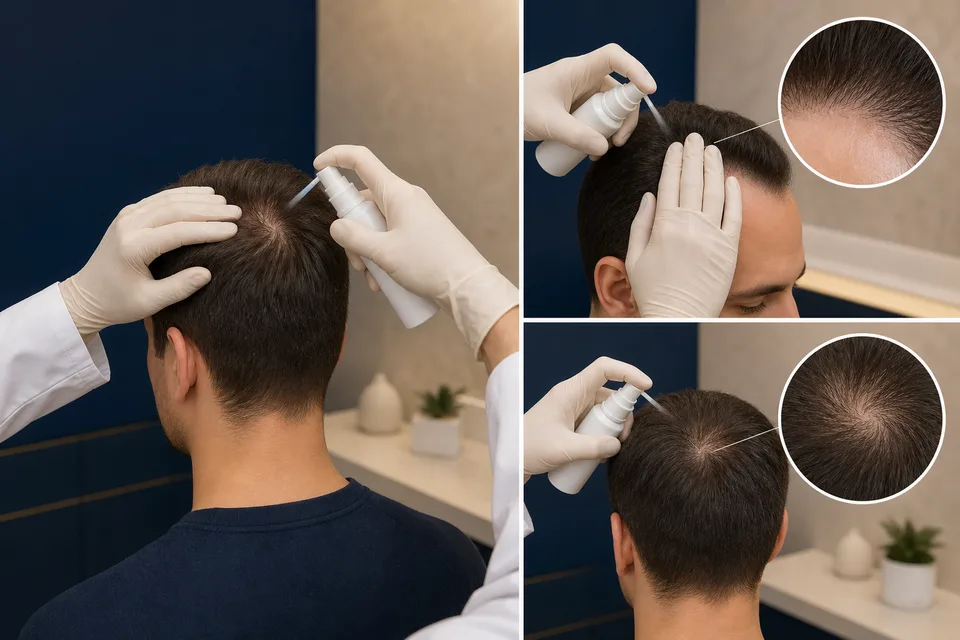
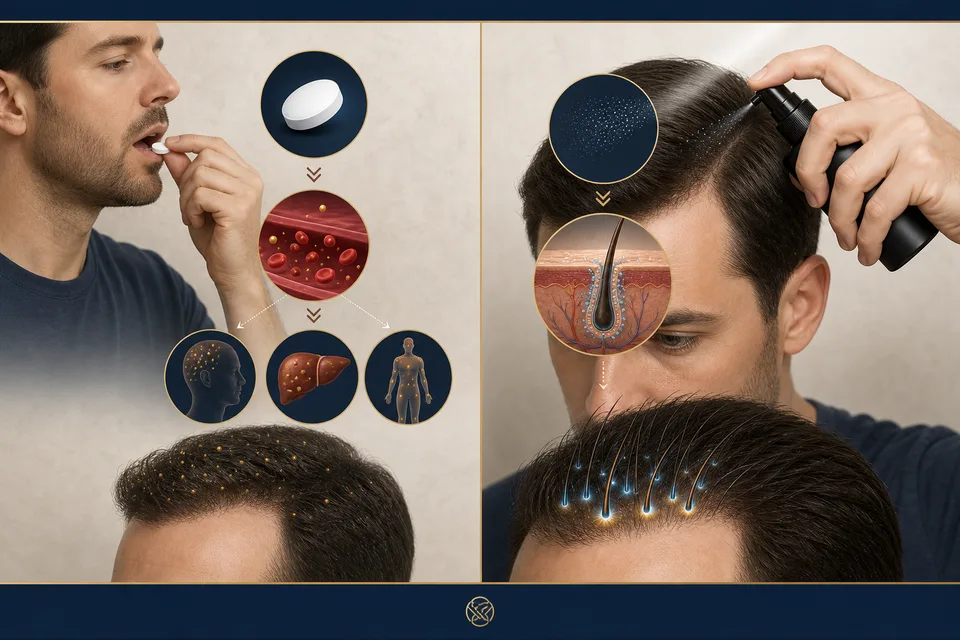
Most people know finasteride as a tablet. Topical finasteride is a different formulation — a solution or spray applied directly to the scalp. The goal is the same: to interrupt the hormonal process that drives pattern hair loss. The route is different: rather than entering the body through the digestive system, the active ingredient is absorbed through the skin at the point where it is needed most.
Topical finasteride is available at HTC as a prescription option, assessed individually by our clinical team — not issued without examination and medical history review.
Same clinically established ingredient. Applied where the problem is — directly to the scalp.
What the research shows
The evidence base for topical finasteride has developed substantially over the last decade. Here is an honest account of what it tells us.
A Phase III clinical trial found that topical finasteride spray produced significant improvements in hair density versus placebo over 24 weeks, with sexual side effects comparable to placebo in that trial population. Phase III is the highest standard of clinical trial before a treatment reaches patients — and the comparison to placebo on sexual side effects is what many men with concerns about oral finasteride want to understand. That is a meaningful finding, but it describes a trial population — not a guarantee for every individual patient.
Evidence suggests topical finasteride may reduce the risk of systemic side effects associated with oral finasteride, due to lower levels reaching the bloodstream — though it is not risk-free and requires clinical assessment. Systemic absorption still occurs. It is lower, but not absent. We will not tell you this treatment is free from risk — that would be inaccurate and unfair to you.
Individual results vary. Topical finasteride is a prescription medication. All claims on this page reflect published evidence — not a guarantee of your personal outcome.
Topical vs oral finasteride: an honest comparison
Many men arrive at this page because they have researched oral finasteride, encountered concerns about side effects, and want to know whether topical is a genuinely safer alternative. Here is our honest answer.
What the evidence suggests:
- Topical finasteride appears to result in lower levels of the active ingredient reaching the bloodstream compared with the oral tablet
- A Phase III trial found sexual side effects comparable to placebo in the topical formulation — a result that oral finasteride trials have not consistently matched
- Evidence suggests topical finasteride may reduce the risk of systemic side effects — but systemic absorption still occurs
What we cannot claim:
- There is no published head-to-head randomised controlled trial comparing topical and oral finasteride directly. We cannot tell you one is definitively safer than the other — only that the systemic exposure profile appears different.
- Post-finasteride syndrome is a serious concern raised by some patients. We take those concerns seriously. Any patient with questions about this should raise it explicitly during their consultation.
Who topical finasteride may suit:
- Men who have been advised against or have chosen to avoid oral finasteride due to side effect concerns
- Men who prefer a targeted, scalp-applied approach
- Patients being assessed for combination therapy (see below)
This is a clinical decision, not a marketing one. Your free consultation is where it gets made properly.
We do not dismiss side effect concerns — from any finasteride formulation. If you have read accounts of post-finasteride syndrome and want to discuss them, please bring them to your consultation. Informed decisions require honest conversations.
Can topical finasteride be combined with other treatments?
Studies have found that combining topical finasteride with topical minoxidil may produce better results than minoxidil alone — though this requires clinical assessment to determine whether it is appropriate for you.
The rationale is straightforward: minoxidil and finasteride work through different mechanisms. Minoxidil extends the active growth phase of the hair cycle and improves blood supply to follicles. Finasteride reduces the hormonal signal that is causing those follicles to miniaturise in the first place. Addressing both processes simultaneously is a logical approach — and the early evidence supports it.
Combination therapy is one of the options your clinician will discuss with you if relevant. It is not a default recommendation — suitability depends on your pattern, your health, and your goals. Read our guide to oral minoxidil for hair loss for the companion prescription option.
Combination approaches are assessed individually. Your plan at HTC is built around your hair — not a standard protocol.
What to expect at HTC
Step 1 — Free consultation. You will meet our clinical team to discuss your hair loss history, your concerns — including any concerns about finasteride — and what you want to achieve. If topical finasteride is appropriate, we will discuss it in full. If it is not, we will tell you why and explore other options.
Step 2 — Prescription and application guidance. If topical finasteride is the right choice for you, a prescription is issued by our qualified clinical team. We will show you how to apply it correctly, explain the timeline for seeing results, and make sure you understand what to expect and what to watch for.
Step 3 — 12 months of aftercare. Every HTC patient receives 12 months of structured aftercare. We monitor progress, adjust the plan where needed, and are available throughout. You will not be prescribed a treatment and left to manage it without support.
One clinician. One patient. Dr Husnain oversees your care from first consultation through to aftercare — you will not be passed around.
Prescription oversight at every step
Dr M Husnain — Hair Transplant Surgeon · GMC: 8023362
All prescription treatments at HTC — including topical finasteride — are assessed, prescribed, and monitored by our qualified clinical team. Dr Husnain leads your care personally.
We understand that some men have concerns about finasteride in any form. Our role is to give you an accurate picture of the evidence, honest information about what we can and cannot claim, and a recommendation based on your individual situation — not a protocol we apply to everyone.
If topical finasteride is not right for you, we will tell you clearly. And we will discuss what is.
- Free consultation — no obligation
- GMC-registered clinical team
- 12 months aftercare included
- Clinics in Manchester, Birmingham, Bristol, London, Walsall
Frequently asked questions
How is topical finasteride applied?
Topical finasteride is applied directly to the scalp — typically as a solution or spray — in the areas affected by hair loss. Your clinician will give you specific application guidance when the prescription is issued. Most protocols involve once-daily application. Correct application matters for both efficacy and minimising unnecessary skin exposure, and we make sure every patient understands the process before leaving their appointment.
Is topical finasteride safer than the tablet?
Evidence suggests topical finasteride may reduce the risk of systemic side effects associated with oral finasteride, due to lower levels of the active ingredient reaching the bloodstream — but systemic absorption still occurs, and topical finasteride is not risk-free. A Phase III trial found sexual side effects comparable to placebo with the topical formulation, which is a positive finding — but we cannot extrapolate that result to every individual patient. The honest answer is: the systemic exposure profile appears more favourable than oral finasteride, but it still requires clinical assessment and monitoring. Your consultation is where we work out whether the benefit-risk balance is right for you specifically.
Can I switch from oral finasteride to topical?
Some patients do switch — particularly those experiencing side effects with the tablet, or those who want to explore whether lower systemic exposure improves tolerability. If you are currently taking oral finasteride, please do not stop or change your treatment without clinical guidance. Bring your current medication history to your consultation and we will discuss the right approach for your situation.
How long until I see results?
Hair is slow. In clinical trials, meaningful improvements in hair density were observed at 24 weeks. Most patients assessing their own results realistically should plan for a 6–12 month timeframe. We build that expectation into your plan from the start so you are not left wondering whether the treatment is working too early in the process.
Is topical finasteride licensed in the UK?
Topical finasteride is currently available in the UK as a prescription medication — your clinical team can advise on the current regulatory status at the time of your consultation, as the licensing landscape for this formulation continues to evolve. What matters clinically is that it is prescribed by a qualified and GMC-registered clinician following a proper assessment — which is the standard at HTC for all prescription treatments.
What about women — can they use topical finasteride?
Finasteride — in any formulation — is not recommended for women of childbearing age, and topical finasteride is no exception. Women who are pregnant or may become pregnant should not handle crushed finasteride tablets, and should exercise caution with topical formulations. Women experiencing hair loss should book a consultation to discuss what treatments may be appropriate for their situation — the options and evidence base differ from male pattern hair loss. We will give you an honest assessment.
Find out if topical finasteride is right for you
Concerns about side effects should not stop you exploring your options. Our free consultation is a proper clinical conversation — honest about what the evidence shows and what it does not. No obligation. No pressure.
Clinics in Manchester · Birmingham · Bristol · London · Walsall
Results evidence
Documented cases.
Before-and-after photography is published only with patient consent and clinician review. Individual results vary and are discussed through consultation.
Published cases will appear here once consent and clinician review are complete.
Individual results vary. Images are published with patient consent only.
Free consultation
Start with clinical clarity.
Book a free consultation to discuss suitability, treatment options, and personalised next steps with a clinician-led clinic.
Confidential enquiry. No obligation. Pricing is personalised after consultation.