Supportive in-clinic care
Mesotherapy for Hair Loss UK
Microinjection of nutrients into the scalp, discussed after assessment — as supportive in-clinic care within a wider plan, with measured expectations at a free consultation.

In brief
Mesotherapy for hair loss involves shallow microinjections into the scalp, delivering a clinician-selected blend of vitamins, minerals, and other ingredients aimed at supporting the follicle environment. It is an in-clinic supportive treatment — not surgery, not a standalone cure, and not suitable for everyone. At HTC, mesotherapy is discussed only after consultation when it may fit your diagnosis, goals, and wider plan. Results are not guaranteed.
What is mesotherapy for hair loss?
Mesotherapy uses very fine needles to place small amounts of solution into the middle layer of the skin (the mesoderm) across thinning areas of the scalp. The exact blend and technique vary between clinics; at HTC the approach is clinician-led and tailored after examination — not sold as a generic “cocktail” without assessment.
The aim is supportive: to complement medical therapy, other in-clinic options, or longer-term planning — not to replace procedures that redistribute follicles when that is what you need.
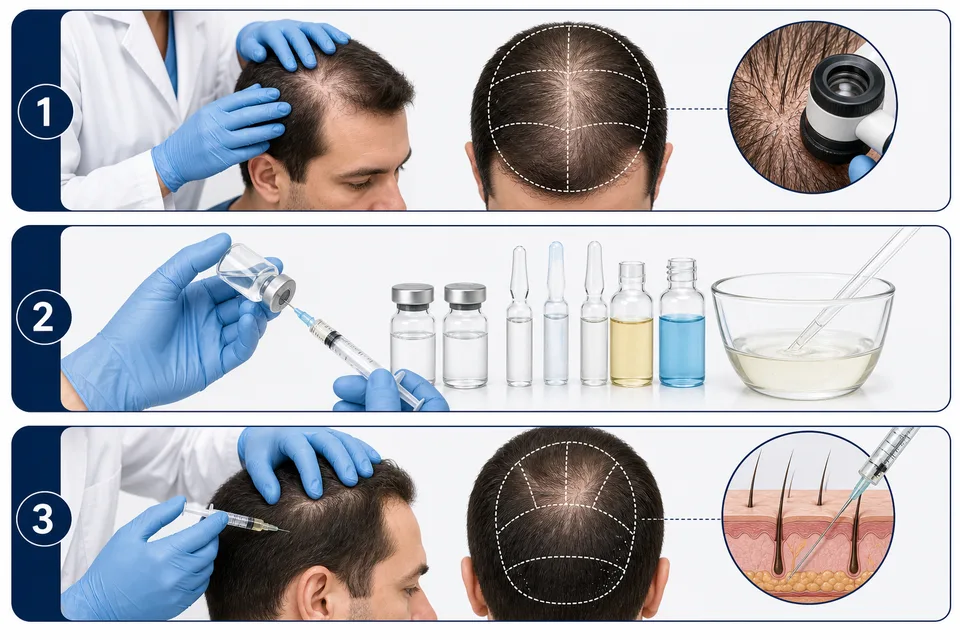
A typical pathway starts with assessment and plan confirmation, then in-clinic preparation and targeted microinjections — spacing and ingredients are agreed at consultation.
Who may mesotherapy suit?
Mesotherapy is most often discussed when hair loss has been assessed and a supportive, non-surgical option may help as part of a broader plan. Common consultation reasons include:
- Pattern thinning where follicles may still be active and in-clinic support is being explored
- Patients already on or considering medical therapy who want adjunct care discussed on clinical grounds
- Supportive care before or alongside other treatments — with clear sequencing, not overlapping without reason
- Scalp health and tolerance reviewed first (active infection, significant inflammation, or certain medical histories may rule mesotherapy out)
Mesotherapy is less likely to be appropriate when hair loss is advanced with little viable follicle activity, when the primary goal is permanent redistribution of follicles (surgery may be the relevant discussion), or when another treatment should take priority. We will say clearly at consultation if mesotherapy is not the right step.
What happens during treatment?
Your pathway begins with a free consultation: history, scalp examination, and an honest discussion of what mesotherapy can and cannot achieve for you.
If mesotherapy is agreed, treatment takes place in clinic. The scalp is cleansed; very fine needles deliver the planned solution into mapped zones. Sessions are usually relatively short, but course length and spacing depend on your clinical picture — we do not publish fixed package counts online.
Topical numbing may be discussed where appropriate for comfort. Written aftercare guidance is provided. Progress is reviewed against expectations set at the start — not against marketing promises.
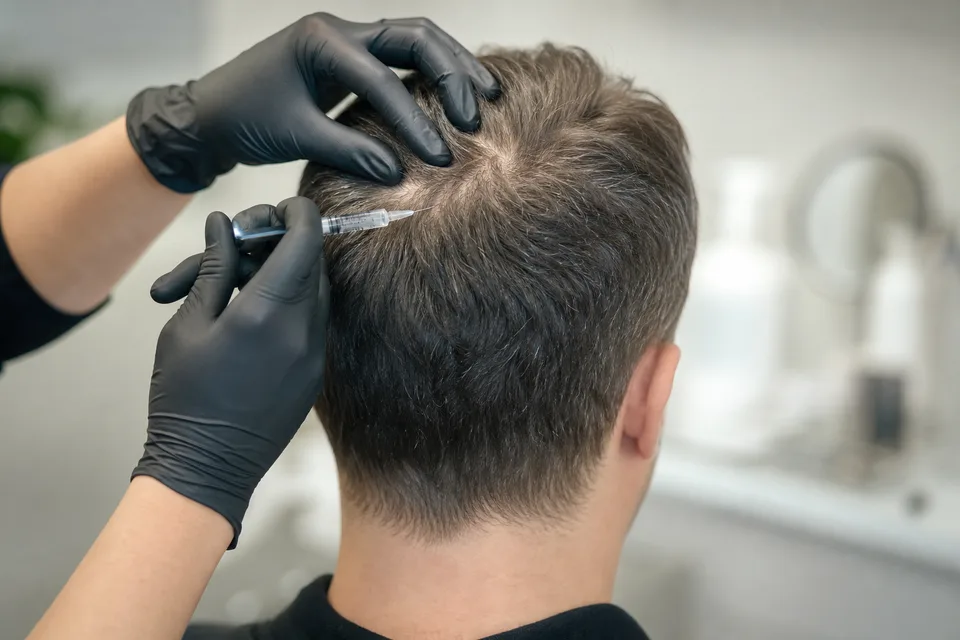
Delivery is shallow and mapped to thinning zones — technique and depth are confirmed for your scalp at consultation.
Mesotherapy at HTC — supportive, not standalone
We position mesotherapy as supportive in-clinic care within a clinician-led plan. It may be discussed alongside medical treatments, PRP, or when protecting native hair matters — but only when clinically appropriate.
Sessions are available at our UK clinics in Manchester, Birmingham, Bristol, London, and Walsall. Personalised pricing is discussed after assessment; we do not list fixed menu prices online.
When permanent restoration of density through follicle redistribution is the goal, FUE hair transplant or other surgical options may be the relevant conversation — mesotherapy does not substitute for that.
Recovery and aftercare
Most patients return to normal daily activity the same day. Mild redness, tenderness, or small marks at injection sites can occur and usually settle within a short period — your clinician explains what to expect for your treatment plan.
Follow aftercare instructions on cleansing, sun exposure, and when to resume other scalp products or treatments. If you have concerns between sessions, contact the clinic rather than self-treating.
Honest expectations
- Mesotherapy is not a cure for hair loss and does not work for everyone
- It is not a replacement for hair transplant surgery when redistribution of follicles is the goal
- Ingredients, depth, and session spacing vary — outcomes are not guaranteed
- Visible change, when it occurs, follows hair growth cycle timelines — typically months, not days
- Combining treatments may be appropriate only when clinically justified — more sessions are not always better
Frequently asked questions
How much does mesotherapy for hair loss cost in the UK?
Cost depends on your pattern of loss, the course recommended, and whether mesotherapy is standalone or part of a wider plan. HTC discusses personalised pricing after a free consultation — we do not publish fixed menu prices online.
How many mesotherapy sessions will I need?
There is no universal package. Initial courses and maintenance intervals differ between patients and clinics. Your clinician confirms spacing and review points at consultation — we do not apply a one-size-fits-all schedule.
Can I combine mesotherapy with PRP or medical treatments?
Sometimes, when clinically appropriate. Supportive treatments serve different roles; sequencing matters. HTC plans on clinical grounds — suitability for combination therapy is confirmed at assessment, not assumed from marketing copy.
How is mesotherapy different from a hair transplant?
A hair transplant surgically moves follicles from a donor area to areas of loss. Mesotherapy is a non-surgical microinjection aimed at supporting the existing scalp environment — it does not replace lost follicles. Your consultation clarifies which pathway fits your goals.
Does mesotherapy hurt?
Fine needles and shallow delivery are used; mild discomfort during or after treatment is common for some patients. Topical numbing may be discussed where appropriate. Your clinician explains what to expect before you proceed.
Is mesotherapy worth it for hair loss?
For suitable patients, it may be worth exploring with realistic expectations — as supportive care, not as a guaranteed fix. Evidence and protocols vary between clinics; suitability is decided in consultation. It is not a substitute for transplant when surgery is the appropriate goal.
Understand whether mesotherapy is appropriate for you
Free, no obligation. We will assess your hair loss pattern, explain what supportive in-clinic treatment can and cannot achieve, and outline a plan only if it is clinically appropriate.
Results evidence
Documented cases.
Before-and-after photography is published only with patient consent and clinician review. Individual results vary and are discussed through consultation.
Published cases will appear here once consent and clinician review are complete.
Individual results vary. Images are published with patient consent only.
Free consultation
Start with clinical clarity.
Book a free consultation to discuss suitability, treatment options, and personalised next steps with a clinician-led clinic.
Confidential enquiry. No obligation. Pricing is personalised after consultation.